
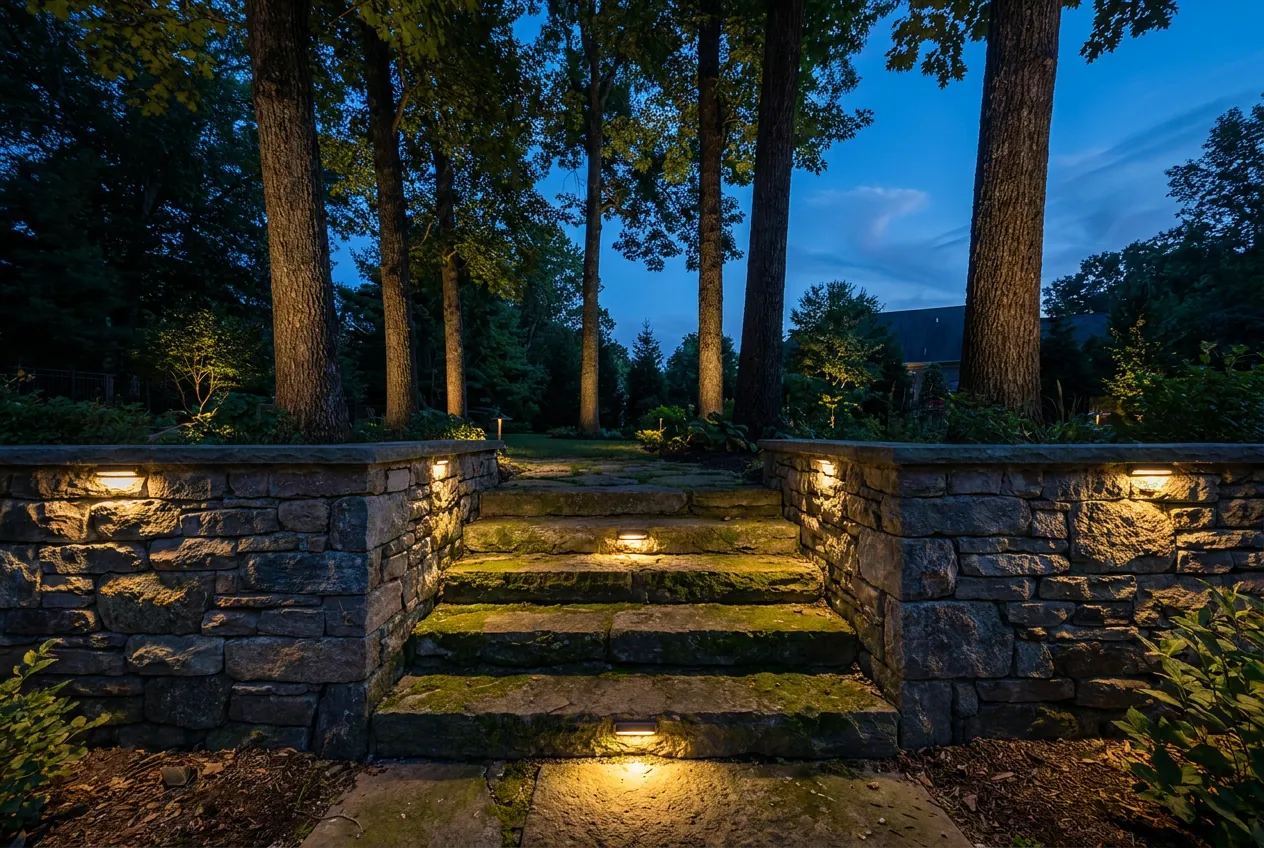
What can be lit?
Steps and changes in level come first, because that’s where people trip. After that: the path from the driveway to the front door, the face of a stone wall, the seat wall around the fire pit, the edge of the deck, a tree in the front yard, the columns at the end of the drive. Good lighting picks a few things to show off rather than flooding the whole yard.
Types of fixtures
Step lights sit in the riser and throw light across the tread. Wall lights tuck under a cap so the light washes down the face of the stone. Path lights stand along a walk, uplights sit at the base of a tree or wall, and small puck lights can be set right into a paver. Over a patio or a pergola, string lights with Edison-style bulbs add a softer glow. Brass and copper fixtures last longest outdoors and weather to a dark finish; painted aluminum costs less.
How low-voltage lighting works
A transformer plugged into an outdoor outlet steps the house current down to about 12 volts and feeds the fixtures through buried cable. It’s safe to run shallow along beds and walls, and modern LED fixtures use so little power that a whole yard costs very little to run. A timer or photocell turns everything on at dusk, and the transformer plugs into a GFCI outlet.
Best installed with the hardscape
Lights are easiest and cleanest to install while a wall, patio or set of steps is being built: the cable runs behind the stone, the fixture sits in a cut block or under the cap, and nothing is left exposed. We can also add lighting to an existing yard, and a shallow cable trench still needs a call to Tennessee 811 first.
Light that stays in your yard
Fixtures aimed down and shielded keep the glow on your steps and plants, out of your neighbors’ windows, and leave the stars visible from the porch. DarkSky International’s approved-fixture program asks most fixtures to send 95 percent of their light below 80 degrees, a good test for anything you buy.