
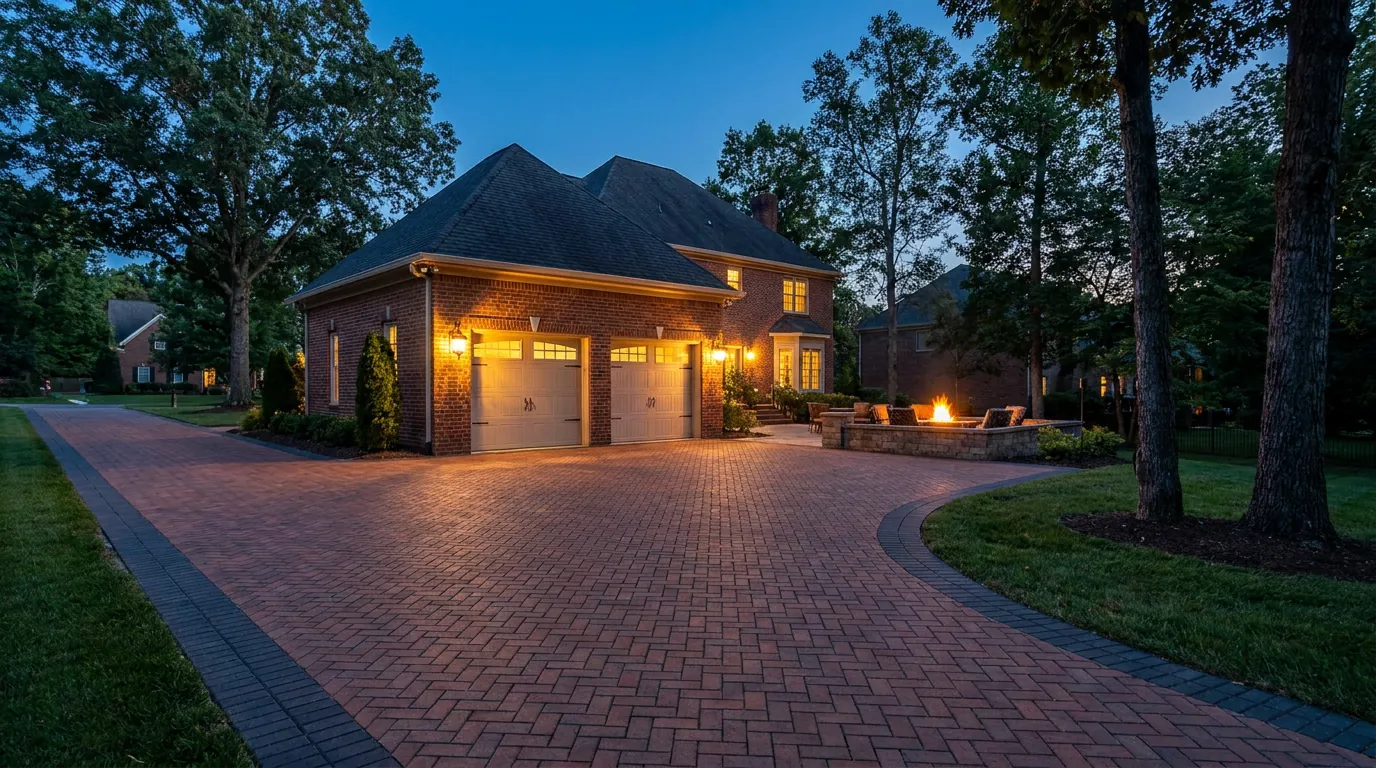
Concrete, pavers or brick?
Concrete is the most common choice: quick to place, clean-looking and the least expensive per square foot. Pavers cost more but give you color and pattern, and a damaged section can be lifted and relaid. Clay brick is the classic match for an older brick house and holds its color for good. Many driveways mix them, with a concrete field and a paver or brick border, or a decorative apron where the drive meets the street.
Finishes and borders
A broom finish gives concrete grip in the rain and is the standard for driveways. Saw-cut or tooled joints can be laid out in a grid that suits the house rather than wherever is convenient. On paver drives, herringbone is the pattern of choice because it locks together under turning tires. A soldier course along the edges gives a crisp finished line.
Built for the weight
A driveway carries a lot more than a patio. The Tennessee Concrete Association’s guide to ACI 332 calls for a slab at least 3½ inches thick in 4,500 psi air-entrained concrete, the mix that stands up to Middle Tennessee freeze-thaw. Paver and brick drives sit on a deeper base than a patio, at least 6 inches of compacted stone.
Replacing an old driveway
Most driveway jobs start with taking something out: cracked concrete, broken asphalt or gravel. The old surface is broken up and hauled away, soft spots in the base are dug out and rebuilt, and the new drive is graded so water runs to the street rather than into the garage.
What affects the cost?
Length and width, the material, how much has to be removed first, the slope up from the street, and extras like a border, an apron or a parking pad beside the drive.
Sources
- Tennessee Concrete Association, ACI 332 for driveways — minimum thickness and the Tennessee mix
- CMHA Tech Note PAV-TEC-002 — base under a paver driveway